Jonathan Senchyne is a Professor of Book History and Print Culture in the Information School at the University of Wisconsin–Madison, where he directs the Center for the History of Print and Digital Culture and serves as Director of Graduate Studies for the M.A. in Library and Information Studies. He is Faculty Director of Chadbourne Residential College, a 580-student living-learning community exploring the liberal arts and sciences tradition at UW–Madison. Since 2024, he has been Associate Editor of The Papers of the Bibliographical Society of America.
He holds affiliated faculty positions in the Department of Art History, the Center for Design and Material Culture, and the Material Culture Studies program.
Senchyne came to UW–Madison after earning his Ph.D. in English at Cornell University. He has been a National Endowment for the Humanities Fellow at the American Antiquarian Society and the Pine Tree Foundation Distinguished Visiting Fellow in the Future of the Book in a Digital Age at the Graduate Center of the City University of New York. He is an elected member of the American Antiquarian Society.
He researches and teaches the history of the book and print culture in early and nineteenth-century America, work that extends into American studies, American literary history, critical theory, material culture, digital humanities, and library history. He is the author of The Intimacy of Paper in Early and Nineteenth-Century American Literature (University of Massachusetts Press, 2020), along with over a dozen essays in journals including Book History, Technology and Culture, PMLA, and American Literary History.
Short Bio
Jonathan Senchyne is a Professor of Book History and Print Culture in the Information School at the University of Wisconsin–Madison, where he directs the Center for the History of Print and Digital Culture. He is Associate Editor of The Papers of the Bibliographical Society of America and an elected member of the American Antiquarian Society. He is the author of The Intimacy of Paper in Early and Nineteenth-Century American Literature (University of Massachusetts Press, 2020).

 The Intimacy of Paper in Early and Nineteenth-Century American Literature is available!
“The Intimacy of Paper succeeds brilliantly not only as a scholarly contribution for specialists of early and nineteenth-century American culture, but also as an innovative methodological intervention in American Studies more broadly.”—Anglia
“Senchyne shows a commitment to rendering visible those too often invisible—be it women using and collecting rags, women working in paper mills, or African Americans frozen in the stereotypes propagated by print media. In turn, his excellent book allows us another way to understand how women (writers) were bound and unbound in paper.”—Women’s Studies
“The Intimacy of Paper contributes to literary, print culture, book history, and bibliographic studies on several fronts . . . This monograph is a valuable academic resource and teaching text.”—American Literary History
“This is an important and engaging work of scholarship . . . [Senchyne] has succeeded in centering female authors, people of color, individuals involved in the rag trade, and other previously marginalized actors within the literary history of American paper and papermaking.”—Papers of the Bibliographical Society of Canada

The Intimacy of Paper Reviewed in Public Books.
“To foreground paper’s place in book production, Senchyne shows, is to reimagine it as a circuit that encompasses rags and linen, the hands they passed through and the indiscriminate mass of heterogeneous bodies that wore them.”
“The affordances of paper—far-reaching as they are—rest on such vicissitudes: the interactions of ink, plant fibers, and the animal-based “sizing” used to limit absorbency. Paper’s story is conventionally one of human ingenuity and progress toward efficiency. But here, in these studies, Senchyne and Calhoun replace ingenuity and efficiency with glitches, failed experiments, and recalcitrant matter: the unpredictable relations between embodied subjects and the physical world. Seen close-up like this, paper’s story is as uneven and bumpy as the surface of rag paper itself.”
 Against a Sharp White Background: Infrastructures of African American Print is available!
“This collection challenges mainstream book history and print culture to understand that race and racialization are inseparable from the study of texts and their technologies.”
“The questions that Fielder and Senchyne introduce offer paths for further investigation and refinement of our key terms of study. Moreover, by bringing scholars from a range of historical fields and subspecialties to a single volume, Against A Sharp White Background makes a compelling argument for collaboration among scholars of various geographies and historical periods. The collection pays forward the promise of theoretically charged engagements with the materials, processes, and products of African American print.”
—The Papers of the Bibliographical Society of America


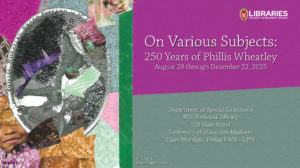
Fall 2023: On Various Subjects: 250 Years of Phillis Wheatley co-curated by Fielder and Senchyne on view at UW-Madison Special Collections:
“Meantime the colleges, whilst they provide us with libraries, furnish no professor of books ; and I think no chair is so much wanted.”
Ralph Waldo Emerson, "Books."